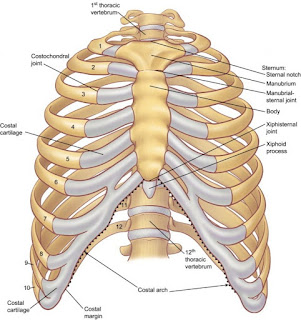
The ribs are associated with protection, affection, and one’s family tree (the family unit).
Their biological function is to protect vital organs such as the heart—the seat of affection—and the lungs, which represent life and freedom.
Consequently, any discomfort, pain, or fracture in this area often reflects conflicts related to a lack of emotional validation—such as not feeling loved or protected—or a perceived inability to protect others.
Biologically, the primary purpose of the ribs is to strengthen or add flexibility to the structure that safeguards life (the heart and lungs) in the face of aggression originating from within one’s family or immediate environment.
Emotional conflicts associated with the ribs include:
First, a conflict involving a lack of protection: feeling that those you care about are failing to protect you.
This may involve living in fear of being encroached upon, criticized, or attacked by members of your own “pack,” or feeling burdened by the obligation to protect and save every member of your family—a weight that feels crushing.
It can also manifest as feeling defenseless against criticism, aggression, or the dynamics of your immediate environment—a sense that “I am not protected by my own family; I am left completely exposed to danger.”
Another conflict linked to the ribs is a lack of emotional validation:
Not feeling loved, acknowledged, or respected within your family circle or immediate environment—for instance, feeling that “in this house, I am worth nothing; no one respects my value or recognizes what I do.”
There is also the conflict of “lacking air” or feeling “territorially suffocated”—a connection rooted in the fact that the ribs expand and contract with every breath.
This occurs when you find yourself in a situation where your vital space is being taken away, or you feel “suffocated”—such as when living with a highly controlling person or being trapped in an oppressive job.
You might feel, “I need more space to breathe—to live—but I am not being allowed that space,” or “The love from my family suffocates me; it imprisons me and strips away my freedom.”
Likewise, the ribs can be affected by a conflict involving the collapse of the “pillar of the family”:
If you have taken on—or have had imposed upon you—the role of being the absolute pillar or support for those around you, your ribs bear the weight of that structural pressure.
This occurs when you feel that you can no longer keep everyone safe, or that the entire structure will collapse if you falter: “I am not strong enough to hold up this weight.”
The “impossible embrace” conflict, or the desire to hold someone close: The ribs forms the structure that is engaged when we embrace another person.
This involves a conflict linked to forced separation or loss—the intense, desperate desire to embrace and protect someone (a child moving far away, a partner leaving, or the death of a loved one) while being unable to do so: “It pains my chest that I cannot embrace, protect, or hold onto the person I love.”
Alternatively, it may stem from feeling that the embrace or “love” offered by a family member is toxic, suffocating, or trapping—leading to a desire to break that structure in order to set yourself free: “This situation (or this person) is suffocating me; it steals my breath and prevents me from living in peace.”
Connection to the “project-sense” (the period surrounding conception and gestation):
A baby “interprets and absorbs” the silent dramas of their parents.
An issue affecting the ribs during early childhood often points to the oppression or emotional suffocation that the parents were experiencing at that time.
It may also be linked to memories from the time of pregnancy, during which the mother felt attacked, vulnerable, or unprotected by her environment (or by her partner).
A “bridge” or “reparative” child—a role that can be programmed even before conception—is an unconscious function assigned to the child: to bring the parents together or to hold up a family structure that was at risk of collapsing.
Meaning according to your biological laterality (if you are right-handed):
Ribs on the right side (collateral/social side): Conflicts involving a partner, siblings, friends, coworkers, business associates, or one’s father.
Ribs on the left side (filial/maternal side): Represents vertical relationships—conflicts “upward” with the mother or female ancestors, or “downward” with one’s children (or pets/projects that you protect as if they were your own children).
If you are biologically left-handed, these functions are reversed.
If you want to know more about the emotional origin of diseases or learn about the purpose of the soul, you can purchase my books by clicking on the Amazon link: