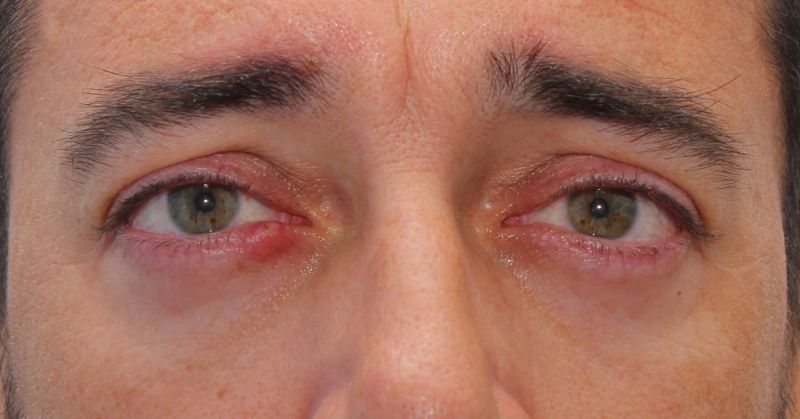
A chalazion represents an emotional conflict linked to “filth” or a “stain” within one’s field of vision, coupled with a deep need for visual protection.
Unlike a common stye (which is typically an acute, fleeting reaction to anger), a chalazion is a chronic, encysted lump, suggesting that the underlying emotional conflict has been harbored or repeated over time.
The biological purpose of a chalazion stems from the eyelid’s protective and lubricating functions; it arises from a need to create a visual shield or to “thicken” tears in order to trap an impurity—whether actually seen or merely imagined.
This eyelid lump, or chalazion, is associated with the following conflicts:
First, a chalazion may appear following a conflict involving “visual filth” or immorality:
This is the most common trigger. It is activated when you witness a situation you deem dirty, disgusting, unjust, or morally unacceptable, yet find yourself forced to continue living with it.
Examples include witnessing infidelity, discovering financial deception within the family, observing corrupt or “dirty” workplace dynamics, or witnessing abuse (verbal or physical) directed at others or yourself.
Unable to process the situation, your body “blocks” your vision through inflammation.
Second, it may stem from a conflict involving dishonor or an attack on your integrity: This relates to the perception that the way others look at or treat you violates your dignity.
Examples include feeling harshly judged, receiving looks of contempt or destructive criticism, or feeling publicly humiliated.
The eyelid reacts by attempting to protect the eyeball from this external “attack.”
Thirdly, a chalazion can arise from a visual separation conflict (wanting—or not wanting—to see):
The chalazion acts as a “screen” or blind that obstructs your field of vision.
This stems from two opposing biological needs:
Not wanting to see: A deep desire to “erase” or stop seeing a person or situation that causes you suffering or stress (for example, having to see an abusive boss or a former colleague every day).
Fear of losing sight of someone: In some cases, it is triggered by an obsessive fear of losing sight of someone you consider essential to your safety or survival.
Additionally, a chalazion may stem from a “Project-Sense” conflict (events surrounding gestation):
Sometimes, the symptom arises from information inherited from our parents during the nine months prior to conception, the pregnancy itself, or the first three years of life.
If, while you were in the womb, your mother witnessed a major family secret or an act of infidelity, or had to “turn a blind eye” to a very serious situation to keep the family together, you might develop a chalazion in adulthood when experiencing a situation that bears even a slight resemblance to that event.
Your body is reacting to the stress your mother was unable to resolve.
Another cause may be a transgenerational conflict (involving family secrets and “shameful” matters):
A chalazion represents a “cyst”—something hidden that does not come to light.
In the family tree, this is linked to family secrets considered shameful or “dirty.”
Hidden abuse, unacknowledged children, fraud between siblings, or deaths covered up to avoid gossip or social judgment.
If you carry the burden of an ancestor who had to remain silent and hide something “very dirty” they witnessed, your unconscious mind may somatize that concealment as an eye cyst.
Finally, a chalazion can stem from a conflict related to “the predator’s gaze” or a fear of being discovered: Meibomian glands secrete oil to lubricate the eye.
If you feel you are in a hostile environment where you are constantly being watched, the body alters your vision.
“I need to camouflage myself or cover my eye so that the predator (a controlling boss, an authoritarian parent, a jealous partner) doesn’t discover what I am doing or thinking.” It is a conflict of pure survival: hiding from another person’s gaze.
What situation or behavior of someone around me do I consider “dirty,” intolerable, or morally wrong?
From what or whom am I trying to protect myself visually?
Have I been harboring resentment for a long time over something I saw but was unable to express?
If you want to know more about the emotional origin of diseases or learn about the purpose of the soul, you can purchase my books by clicking on the Amazon link:
Image:miranza.es