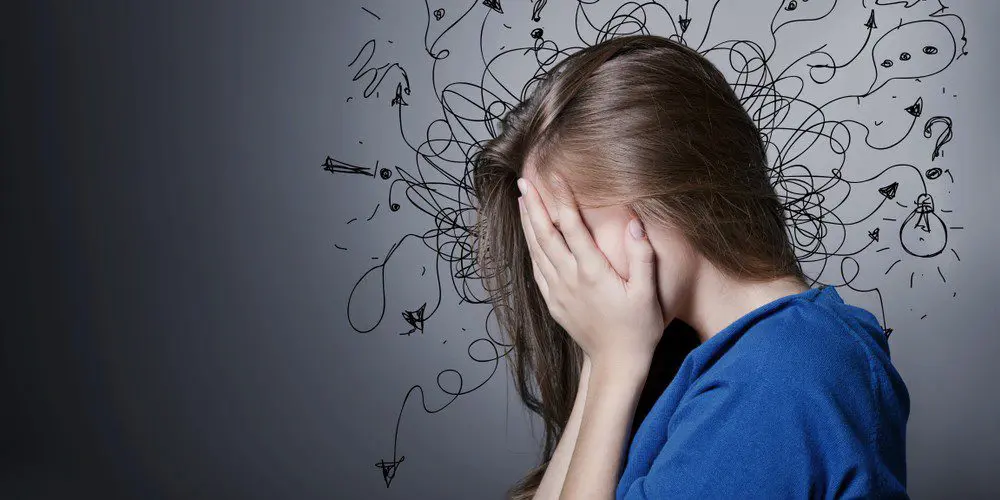
Anxiety is the term that designates the fear that a person feels in the face of an impending danger, be it real or imagined.
Likewise, it also tells us about the feeling of fear of the future, of what may come or happen, due to lack of control over it.
Anguish is a fear for no apparent reason that manifests itself in those people who distrust the process of life.
The anguished is surrounded by a cloud of fear that isolates him, limits him and causes a feeling of separation.
The sympathetic system is triggered and takes control of the body to avoid a danger.
The reactions of the sympathetic system can be of four types: fight, flight, paralysis or submission that gives a different variety of anxiety reactions.
The difference between a normal reaction of the sympathetic system and the one that produces anxiety is that in the second case the danger is in our unconscious (it may be more or less real, but we are not aware that the danger is there).
That means that we cannot react to that fear as it would be appropriate, since either it is not manifested, or that reaction would imply an even greater problem than we have.
Then a blockage is created, but its meaning remains the same: “play dead, submits, flee or fight with the problem”
It is important to know that anxiety is actually a conscious (expressed) emotion that hides another in the unconscious that has not surfaced (not expressed).
This second is the one that really matters to us, it is the one that causes us anxiety.
Trying to solve the anguish as if it were a disease is useless, since it is only a manifestation of the unconscious to warn us that we are ready to face the new challenge that life has in store for us.
It is like an engine that is started so that we can undertake a new task and be able to achieve that deep longing that we carry within and that will lead us to a new state of consciousness.
Anxiety tells us that some part of us lacks life or is dying, for example, “this job is killing me” or “something in my work, in my partner, family, is dying”.
Anxiety is the force that the unconscious sends us to give life to that which is dead.
What are the parts of our life that are dying?
What do I want to end and I don’t know how to end it?
Once we find out, we must be honest and willing to change and go for what we want.
We will have to study the whole situation and make a plan to achieve what we want.
In some way, anxiety is showing us that we feel devalued, limited, powerless and incapable of facing a situation, a challenge that life puts before us.
The word “anguish” for narrow means narrowness, lack of breadth.
The external causes that are most often considered as triggers of distress are: abandonment, loneliness, failure, rejection, war, etc.;
But without a doubt, the true cause is found in the personality, in the mental closure, in the lack of amplitude of thought, in the inability to live from the emotional center whatever is happening, in an exaggerated feeling of separation.
Anxiety in the human being denotes a lack of confidence, (that is why it has the tendency to regress when an obstacle is presented), of value, of self-esteem and of self-love.
In some cases, the anguish betrays an exacerbated selfishness.
On some occasions, the unconscious emotional conflicts that give rise to anxiety have a transgenerational origin (family tree) or in the Project Sense stage (conception period, pregnancy and up to 3 years of age).
It is very important to find out and understand the origin of the unconscious program that triggers anxiety.
Finding the “why” and changing the beliefs associated with those fears and fears to free ourselves.
If you want to know more about the emotional origin of diseases or learn about the purpose of the soul, you can purchase my books by clicking on the Amazon link:
Image:theblackberrycenter.com