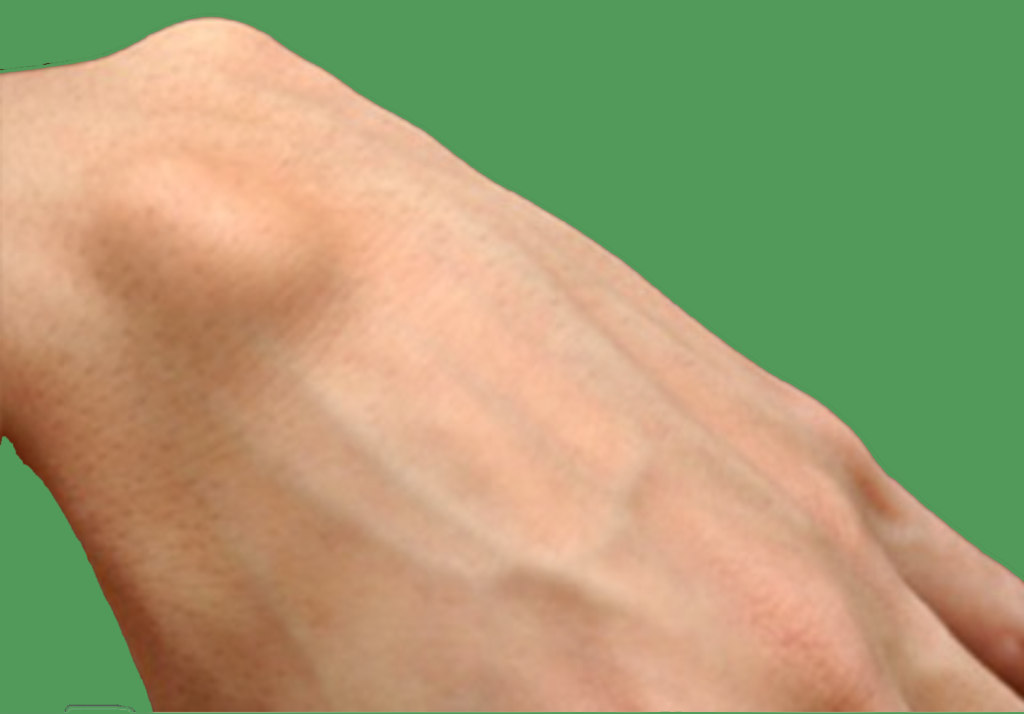
A wrist cyst (known as a synovial cyst or ganglion) represents an accumulation and retention of emotions, tears, or thoughts that you have not allowed yourself to express or act upon.
Biologically, a cyst is a sac filled with encapsulated fluid.
On an emotional level, water represents emotions and tears.
Therefore, a cyst encapsulates “the joint’s tears” in response to a conflict regarding professional self-worth or action.
The ganglion always manifests during the second phase, or repair phase: Like pain, the appearance of the cyst usually occurs during the conflict-resolution phase.
When tension or stress subsides, your body encapsulates the excess synovial fluid to protect the tendons that underwent stress.
Biological purpose: The brain sends this extra fluid to the area to separate tissues and prevent the tendons from wearing down or tearing due to repetitive, forced movements—whether physical (mechanical) or those you feel compelled to perform (emotional).
Its function is: “I am placing a fluid-filled sac here so the joint does not suffer the direct impact of a blow or strain.”
The main emotional conflicts causing a wrist ganglion:
Denial of work-related reality (“Turning a blind eye”):
It occurs when you experience a situation in your work environment or daily tasks that deeply displeases you, yet you choose to act as if nothing is wrong.
You encapsulate your annoyance or disagreement within the cyst so you can continue your routine without exploding.
Subtle immobilization or restriction of movement: By occupying space, the cyst subtly reduces the wrist’s range of motion or causes discomfort when you try to bend it fully.
Its purpose is to curb wrist flexibility, prompting you to stop adapting to situations or people that are detrimental to you.
It serves as a warning before pain sets in: it restricts movement to make you stop performing that specific task.
“Symbolic mutilation” conflict or a separation in the act of doing:
Feeling that your capacity to act autonomously has been taken away or “severed.”
This can be triggered if your authority at work is removed, if your duties are unfairly changed, or if you feel you no longer have control over your own creations or tasks.
Containment or holding back of a creative impulse or a change in direction:
You strongly desire to start a new project, change professions, or take a different path involving your hands, but you hold yourself back out of fear or caution.
The accumulated fluid represents all the energy of movement and action that you have repressed and have not allowed yourself to bring to fruition.
Accumulation of resentment due to submission:
Unlike acute pain that alerts you to immediate stress, a cyst involves elements of time and repetition.
It signifies that you have long been harboring anger or a sense of powerlessness in the face of an abusive or coercive dynamic—accumulating “tears” within the joint that you have not released through crying or speaking out.
Resentments stored in the unconscious: The “underlying resentment” is the deep, visceral, and hidden emotion the body experiences just before a symptom manifests.
It is not a matter of logical thought, but of what you feel at a survival level.
In the case of a synovial cyst or ganglion on the wrist, this underlying resentment always revolves around themes of holding back, accumulation, and contradictory actions.
“I hold myself back”: I want to explode, slam the table, quit this job, or smash everything to hell with my hands, but I have to restrain myself and keep up appearances. “I turn a blind eye”: even though I am swallowing an unjust situation, an abuse, or a lie at work, it is preferable to act as if nothing is happening so as not to cause conflict.
“Although I would like to, I don’t allow myself to change course”: despite deeply desiring to start another project or take my life in a different direction, I forbid myself from doing so out of fear of failure or financial instability.
“I don’t allow myself to change course”: I deeply desire to start a new project or take my life in a different direction, but I forbid myself from doing so out of fear of failure or financial instability.
The meaning of the cyst based on its location:
On the dorsal side (top of the wrist): It is often linked to what you “show” the world. It is associated with a desire to halt a project, an external obligation, or work imposed upon you by others.
On the palmar side (underside of the wrist): It relates to your inner world, your private self, or what you try to “keep to yourself.”
It may indicate that you are holding back from grasping what you truly desire out of fear that you won’t be able to achieve it.
Reflections for introspection:
“What action or decision am I holding back on due to fear of the consequences?”
“To what situation or person in my work or daily life am I turning a blind eye, even though it hurts?”
“I give myself permission to stop bottling up my anger and sadness; I choose to express what I truly feel.”
If you want to know more about the emotional origin of diseases or learn about the purpose of the soul, you can purchase my books by clicking on the Amazon link:
Image: fifevirtualhandclinic.co.uk