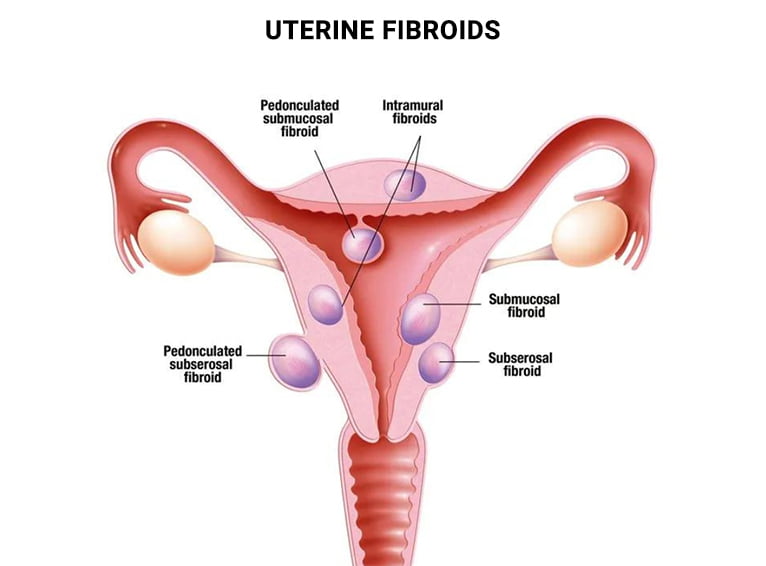
Type of fibroid, based on their location: Uterine fibroids are not viewed merely as a biological malfunction, but rather as a physical response to a deep-seated emotional conflict related to motherhood, creativity, family, and the “nest.”
The uterus represents one’s internal home—the place where life and projects are conceived and nurtured.
Types of fibroids, categorized by their location and emotional meaning:
First, there are intramural fibroids, which develop within the muscular wall of the uterus.
The muscular layer (myometrium) is directly linked to issues of self-worth and structural stability.
A fibroid in this area often reflects a feeling of being “incapable” of sustaining a pregnancy, a fear of not being a “good enough” mother, or a perceived lack of the necessary family or partner support to “hold onto” or protect a child.
It may also symbolize an excessive, strained effort to keep a family together in the face of situations involving submission or abuse.
The body generates additional muscle tissue to make the uterus “stronger,” driven by an unconscious belief that one’s current foundation is insufficient: “I am not strong enough to sustain this nest or my family.”
Secondly, there are subserosal fibroids (located toward the outside of the uterus): Because they grow outward, they represent conflicts projected beyond the “nest.”
They are frequently associated with frustrated projects, goals, or dreams unrelated to biological motherhood—such as a business that failed, a stalled career, or an ideal that “could not blossom.”
They may also symbolize pressure exerted by the external environment or one’s in-laws regarding the role of a mother: “I feel that people from the outside are intruding into my intimate territory, and I am unable to defend myself.”
Another type of fibroid is the submucosal fibroid (located toward the internal cavity):
These grow just beneath the inner lining (the endometrium) and protrude into the uterine cavity.
The endometrium is the tissue that receives the baby.
When fibroids grow here, the conflict is often deeply linked to a child who never arrived or who was lost (such as through pregnancy loss or miscarriage).
The body creates a “mass” within the cavity—mimicking a pregnancy—in an attempt to symbolically “fill” the void or the space left vacant in the nest: “I urgently need to fill the void left by my child.”
They are also attributed to a “symbolic child”—such as a business of one’s own, a creative project, or a piece of work that was abruptly interrupted or never came to fruition.
Finally, there are pedunculated fibroids, which relate to a conflict involving both attachment and separation: you wish to distance yourself from a problem or a person, yet you resist severing the tie completely.
You may feel burdened by a weight or a family responsibility that exhausts you, but a sense of loyalty prevents you from letting go.
You might think, “I cannot break this bond, even though it weighs me down and hangs by a thread,” or “My child—or my project—is drifting away from me (gaining independence), and I am terrified of losing control or contact.”
Furthermore, there is another experience that can lead to the development of a fibroid:
The conflict involving an “infantile” or absent partner. This occurs when a woman perceives her partner as “another child” whom she must support, raise, or protect, rather than as an adult equal.
In the absence of a mature man to “spiritually fertilize” her, the uterus “fertilizes itself,” resulting in the formation of a fibroid.
Similarly, a woman may harbor a deep desire to have a child with a partner who refuses, or she may be unable to conceive due to a separation.
The biological body responds to this fervent desire by creating its own “fruit.”
The impact of the family tree or transgenerational factors: Often, a conflict does not originate in a woman’s own life, but rather in the experiences of her female ancestors (mother, grandmothers, great-grandmothers).
A fibroid may be the manifestation of an “unresolved family drama.” If, within the family tree, there were women who died during childbirth or infants who passed away at birth, the family’s collective unconscious retains the trauma: “Having children is dangerous—or even fatal.”
The fibroid acts as a “plug” or a mass that occupies space, biologically preventing an actual pregnancy and thereby protecting the woman from death.
Furthermore, when past generations have concealed events such as abortions, early deaths, or children born out of wedlock, a fibroid may emerge in subsequent generations to “give a body and a place” to the individual who was excluded or erased from the family history.
If you want to know more about the emotional origin of diseases or learn about the purpose of the soul, you can purchase my books by clicking on the Amazon link:
Image: astraveinvascular.com