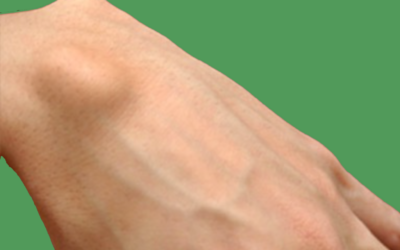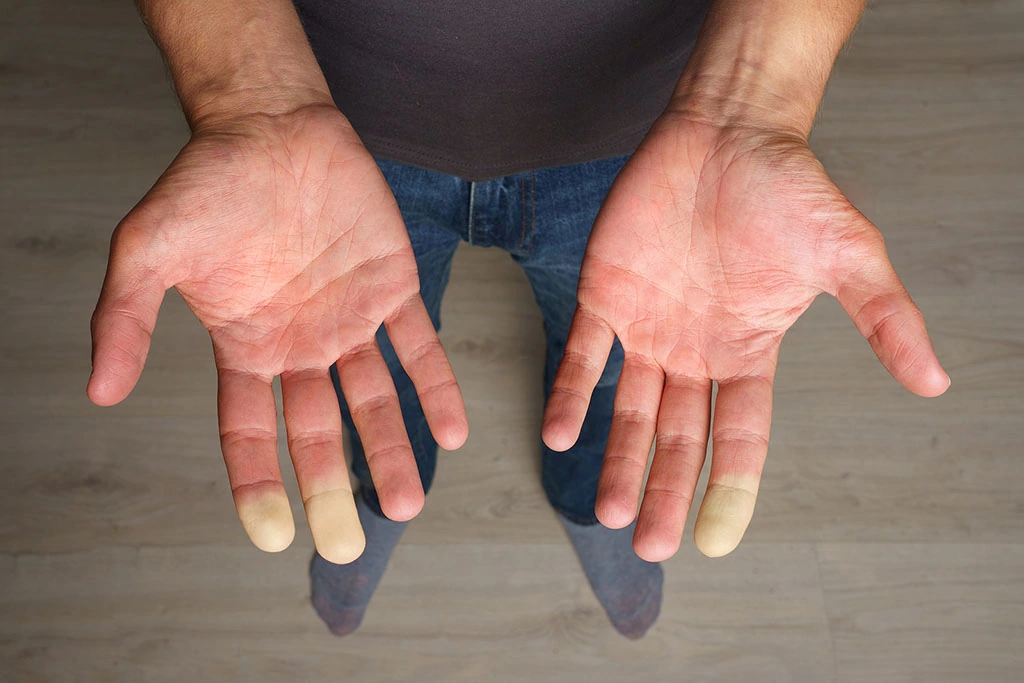
Scleroderma (or systemic sclerosis) is an autoimmune disease that causes the skin to harden and can affect internal organs.
It is interpreted as a physical manifestation of unresolved emotional conflicts related to protection, devaluation, and separation.
The biological purpose of scleroderma is survival through the creation of a shield or protective armor.
The unconscious mind does not distinguish between a real threat (such as a predator) and an emotional or symbolic threat (such as a hostile family environment or constant humiliation).
Therefore, when the brain perceives the environment as extremely dangerous, cold, or aggressive, it activates an emergency solution: hardening the body’s outer boundary—the skin—to withstand the impact. “I must toughen myself so that I cannot be hurt.”
Emotional conflicts associated with scleroderma:
First, a conflict involving a lack of protection or external aggression (“the armor”):
The hardening of the skin is a symbolic response to the need to become “immune” or “tough” in the face of real or imagined attacks.
Scleroderma is frequently associated with memories of having lived under the yoke of a highly dominant, violent, or intimidating authority figure.
The biological unconscious dictates: “I must toughen up so that their blows or words cannot harm me.” “If I show softness or vulnerability, I will be destroyed.”
A conflict involving a dramatic separation or the loss of contact: The skin is the organ of touch and social connection. It may involve feelings such as “I have been torn from someone’s arms” or the abrupt loss of an essential connection.
This refers to a deeply painful, cold, and harrowing separation from someone to whom one was very close—a sense that with their departure (due to divorce, death, etc.), a part of oneself has also been lost.
Examples include: “My mother has died, and without her, I am worth nothing”; “I feel useless ever since I was separated from…”; “I feel terrible that the other person is alone because of me”; or “If this separation happens, it must mean I am useless.”
Furthermore, it may be linked to an emotional conflict involving “liquids” (whether real or symbolic), which can also imply the “crumbling” or “falling apart” of one’s life.
We must pay attention to the symbolism of these “liquids”—which could represent water, money, financial flow, expenses, a mother figure, bodily fluids, the act of extinguishing a fire, rain, a storm, a flood, and so on.
Finally, underlying scleroderma, there may be a conflict rooted in a profound sense of self-devaluation.
As this is a disease that affects connective and supporting tissue, it is often accompanied by a profound sense of inadequacy or “worthlessness” in the face of life’s circumstances (for example, following the loss of an important family or professional role). “No one protects me; I am completely exposed.”
We must consider the significance of the specific area of the body where scleroderma manifests—for instance:
Hands and fingers: These are the most common initial site of the condition.
They represent work, execution, the act of grasping, and the capacity to give or receive.
This may reflect a fear of or resistance to “doing” something, or a feeling that one’s own actions are entirely constrained or oppressed by another person.
It can also signify a conflict related to an “inability to hold onto” someone (separation from loved ones), or an unconscious need to develop a protective “shell” on the hands to avoid being hurt by the work one performs or by the things one touches.
Symbolically, conflicts involving the hands are often associated with the role of the father (the palm) or the provider.
Feet and lower extremities: The feet represent forward movement, one’s life path, roots, and support.
A hardening of the legs or feet symbolizes a fear of moving toward the future, difficulty in deciding whether or not to head in a particular direction, or an emotional paralysis when faced with important decisions.
As the part of the body that connects us to the earth, this area is frequently linked to dynamics involving conflict, submission, or separation in relation to the mother.
The face or the mouth: The face is our calling card and our identity to the world.
The conflict here relates to the fear of “losing face”—of being exposed, judged, or humiliated, or of losing one’s own identity in the eyes of others.
Facial rigidity acts as a shield to hide true emotions and prevent others from “seeing” one’s vulnerability.
A reduced ability to open the mouth often symbolizes an unconscious inability to verbalize something, or to “swallow” a situation or highly aggressive words.
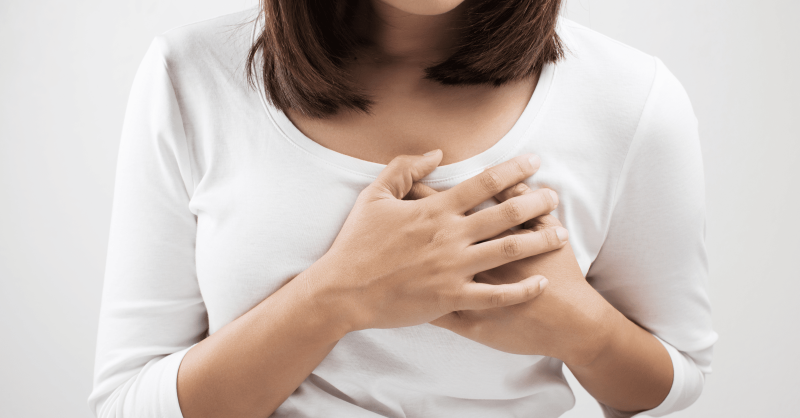
The thorax and abdomen: This affects the body’s protective center, where vital organs reside.
It reflects a need to safeguard one’s own life and most intimate personal space.
It is linked to unconscious memories of direct attacks on the core of one’s family stability or one’s very being (such as abuse, explicit violence, or profound threats to survival).
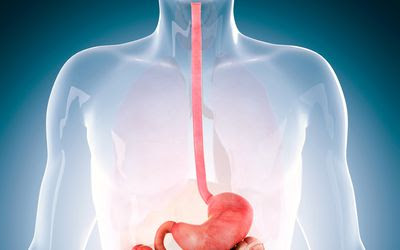
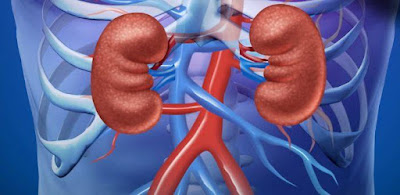
Internal organs (systemic sclerosis): When the condition extends beyond the skin to affect internal systems, the conflicts become internalized, manifesting within specific biological functions of the body.
If you would like to learn more about the emotional origins of illnesses or the purpose of the soul, you can purchase my books by clicking the Amazon link:
Image: raleighmedicalgroup.com